Showing posts with label Trade Gauge. Show all posts

Monday, February 14, 2011

Trade Gauge: Randy Myers and friends for John Franco and friends


December 6, 1989: The New York Mets trade Randy Myers and Kip Gross to the Cincinnati Reds for Don Brown and John Franco.

Mets fallout: This was a weird trade, since it's not very often you see two closers in their prime swapped for one another, especially when they're both left-handed. And yet the Mets and Reds did the deed, sending John Franco back to his hometown in exchange for the angry Randy Myers. Franco was a couple of years older but was also more established, since Myers had only been closing a couple of years at the time of the swap. Franco turned 30 during his first year at Shea and incredibly, played 14 seasons for the Mets, acting as the team’s primary closer until 1999 and tallying 200+ saves during that span. Despite his pointed rear and questionable moustache, Franco was a constant bright spot during an otherwise bleak decade for the Mets and by all accounts, a helluva nice guy.

Reds fallout: Myers teamed with Rob Dibble and Norm Charlton to form the bullpen three-way known as the Nasty Boys, leading the Reds to a shocking 1990 World Series sweep over the bulky Oakland Athletics. The trio was frightening, trashy and entirely dominant for that single season but the combo was clearly living on borrowed time. Dibble soon attacked manager Lou Piniella, they tried to convert Charlton to a starter and Myers was shipped to San Diego after the 1991 season in exchange for the lovable, scrappy Bip Roberts. Roberts kinda flatlined after a massive 1992 for the Reds, returning to the Padres in 1994 and putting together some bold average and steal numbers. As for Myers, he bounced between various clubs: the Cubs, Orioles, Blue Jays and ultimately a disastrous second stint with the Padres that saw Myers pitch horribly after a deadline deal and yet appear in his second and final World Series (where he likewise pitched horribly with a 9.00 ERA as the Padres were destroyed by the Yankees). A quality player whose stats generally sat between good and great (Myers is one of only nine relievers to tally 50+ saves in a single season and sits within the Top 10 of the all-time save lists… Franco is 4th if you’re keeping score) and yet one who seemed to wear out his welcome wherever he went. Best exemplified by a 1995 encounter where Myers wore out his forearm on the face of a Cubs' fan.

The verdict: Easy. John Franco. Better stats. Better attitude. An even swap at the time that is now largely one-sided in retrospect.

Friday, December 24, 2010

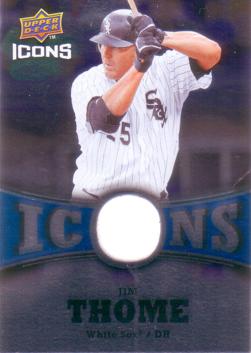
Trade Gauge: Jim Thome for Aaron Rowand and friends


November 25, 2005: The Philadelphia Phillies trade Jim Thome with cash to the Chicago White Sox for Aaron Rowand, Gio Gonzalez and Daniel Haigwood.

Phillies fallout: This move was an inevitability with Ryan Howard no-so-gently nudging Thome out of Philly. As a result, the Phils likely didn't get as much as they could've otherwise, since the 29 other clubs knew Thome was living on borrowed time. BTW why is it whenever you receive an email with a “friendly reminder”, it’s typically not very friendly? Anyway, Rowand was a serviceable haul in retrospect, putting together a good season in 2006 and a great season in 2007. He parlayed this success into a terribly inflated contract with the Giants, ultimately cashing cheques largely from the bench as the Giants captured the 2010 World Series title. Silver lining: Rowand's massive 2007 meant the Phillies let him walk, opening up at-bats in 2008 and beyond for Jayson Werth, a superior player no doubt. As for Gio Gonzalez, he was eventually spun to back to the White Sox during the 2006 offseason alongside Gavin Floyd for a gimpy Freddy Garcia. Guessing that's one swap Phillies GM Pat Gillick would take a mulligan on.

White Sox fallout: Even though he was in his mid-thirties by the time he arrived in Chicago, Thome was still a fearsome, productive hitter for the White Sox, slugging 42 home runs in 2006 and giving them a formable presence, both in their clubhouse and line-up. Thome was flipped to the Dodgers at the 2009 trade deadline for middling middle infield "prospect" Justin Fuller. The White Sox DH position in 2010 was a revolving door, featuring Mark Kotsay and other dregs.

The winner: Let's give this one to the White Sox. Long-term, Gio Gonzalez is probably the most tantalizing vittle in this swap and since the Sox got him back a season later plus received 3.5 years out of Thome, hard to fault the efforts of the ever-erratic Sox GM Kenny Williams.

Sunday, December 12, 2010

Trade Gauge: Bret Saberhagen for Gregg Jefferies and friends


December 11, 1991: The Kansas City Royals trade Bret Saberhagen and Bill Pecota to the New York Mets for Gregg Jefferies, Kevin McReynolds and Keith Miller.

Royals fallout: This was a bold move by the Royals franchise, swapping their 27-year old ace (and former World Series hero... and former two-time Cy Young Award winner) for a couple of spare parts and a enigmatic brat of an infielder. Though I don't recall the specifics, there is no doubt economics played a factor in this swap, namely the Royal erroneous commitments to Mark Davis, Storm Davis and Mike Boddicker--three hurlers who were climaxing when they inked big free agent contracts with the Royals, only to flatline shortly after their arrival in the Midwest. The ascension of Kevin Appier perhaps made this deal easier to stomach on paper but the reality is the Royals went from two games above 0.500 in 1991 to 18 games under in 1992. Ouch. As for the bounty, McReynolds did little to distinguish himself in two seasons for the Royals and was eventually swapped back to the Mets in exchange for the bad contract of Vince Coleman. Jefferies became a solid spray hitter for the Cardinals and Phillies (though hardly the Herculean talent the Mets pimped him as back in 1988). The Miller-Pecota portion of this deal was a bit of a wash.

Mets fallout: While the Mets didn't give up a ton for a legitimate #1 starter (albeit one with a shaky health history), they did ship three regulars to Kansas City and replaced them the following season with two free agents (Willie Randolph and Bobby Bonilla) and a transplant (Dave Magadan, moving over to third base from first base after Eddie Murray was brought in). The 1992 Mets was a team of big money hustlers. But sure didn't play like it, finishing with the exact same 72-90 record as the Royals did. And as for Saberhagen, he only won 29 games in parts of four seasons with the Mets although he was kinda, sorta fantastic in the strike shortened 1994 campaign, finishing third in NL Cy Young Award voting behind Greg Maddux and Ken Hill.

The winner: I was going to award a slight edge to the Royals since they were able to parlay their "winnings" into swaps and decent seasons from Vince Coleman and Felix Jose (acquired after 1992 for Jefferies). But then again, Saberhagen was the only one of the four players to have a real standout season for his new team so slight edge to the Mets, in a swap where all four failed to impress in the big picture. So there.

Tuesday, November 16, 2010

Trade Gauge: Norm Charlton for Kevin Mitchell


November 17, 1992: The Cincinnati Reds trade Norm Charlton to the Seattle Mariners for Kevin Mitchell.

Reds fallout: The Reds really shook up their outfield in the 1992/1993 offseason. Paul O'Neill shipped of to New York in exchange for the pesky Panamanian Roberto Kelly. Reggie Sanders moved up in the order. Bip Roberts moved to the bench. Dave Martinez moved out of town. Mitchell was envisioned as a major bopper for the power-starved Reds but hit only 19 home runs in limited action, albeit with a 0.341 average. He smacked 30 in the strike-shortened 1994 but quickly faded to black in the American League from 1996 onwards. The bullpen suffered without Charlton too with Rob Dibble imploding and imported veterans Jeff Reardon and Greg Cadaret not doing much to pick up the slack.

Mariners fallout: Charlton was supposed to be the antidote to the Mariners longstanding bullpen woes. Amazing Edwin Nunez and Mike Schooler weren't longterm solutions, ain't it? Charlton was effective in 1993... when he wasn't plauged by injuries, which was seldom. He ultimately left the Ms after the season and bounced between seven other teams in subsequent years, including a return visit to the Reds and two, count 'em TWO returns to the Mariners. Lightweights Mike Felder and Greg Litton took most of Mitchell's at-bats for the Mariners but considering Big Kev never really found his stride in the Pacific NW, not a huge loss.

The winner: Let's go with Mitchell. Charlton was far too injured and far too toe-headed to be considered "the spoils" in this value-for-value swap. You don't see closers traded for position players of this magnitude anymore but give the Mariners credit for taking a shot by shipping out the lumpy Mitchell for the fiery lefthander.

Wednesday, November 3, 2010

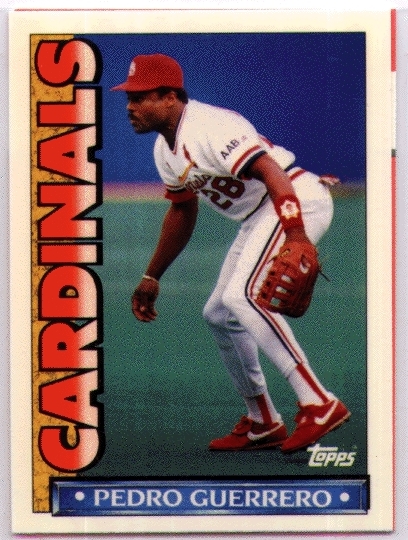
Trade Gauge: Pedro Guerrero for John Tudor


August 16, 1988: The St. Louis Cardinals trade John Tudor to the Los Angeles Dodgers for Pedro Guerrero

Cardinals fallout: The Cardinals spent much of the first half of 1988 yearning for the power bat missing since Jack Clark bolted for the Bronx in the 1987/1988. The found the antidote in Big Pete, an aging slugger but a slugger nevertheless on a team devoid of power. Guerrero did OK for the remainder of ’88 and then put together a big ’89, driving in 117 runs while playing an unspectacular first base. He went back to being OK in ’90 and ’91 before wrapping things up with a release in ’92. For whatever reason, Cardinals’ management just never tried to stock the team with any pop during their era. The team’s first 20 home run hitter didn’t emerge until 1992 when Ray Lankford nailed 20 in his sophomore season. And they didn’t have a 30 home run man in the Nineties until 1996 when the bulbous Ron Gant popped 30. Ironic that only a few years later, the team would employ two of the most severe sluggers of the modern era: Mark McGwire and Albert Pujols

Dodgers fallout: This deal was a bit of a WTF for the ’88 Dodgers. The team was already deep in pitching, anchored by a historical season by Orel Hershiser, a solid rookie campaign by Tim Belcher, a surprisingly solid effort by Tim Leary (not to be confused… or associated with Timothy Leary) and a strong bullpen led by Jay Howell, Jesse Orosco and Alejandro Pena. Not sure why they felt they needed another arm in Tudor but whatever the case, he pitched well down the stretch but then did little of note in the post season, was a gimp in ’89 and ended up back in St Louis for ’90 where he suited up alongside Guerrero and put together a fine 12-4 season to end his career. The Dodgers used spare parts like Franklin Stubbs and Mickey Hatcher to replace Guerrero’s clout in ’88 before importing Eddie Murray for ’89 and beyond. Again, an odd move but they did win the World Series in 1988 so hard to fault them.

The winner: Cardinals. Guerrero wasn’t spectacular during his Cardinals reign but he did put up some decent RBI numbers and besides, Tudor was back in St Louis a season and a half later. Pretty easy to do the math there.