Showing posts with label Book Report. Show all posts

Saturday, February 26, 2011

Book Report: Top 10 WTF No Hitters


Most mundane career stats of pitchers who "twirled" no hitters during the MFS years.

1. Bud Smith (7-8, 4.95 ERA, 81 SO, 1.447 WHIP)
2. Mike Warren (9-13, 5.06 ERA, 139 SO, 1.500 WHIP)
3. Jose Jimenez (24-44, 4.92 ERA, 319 SO, 1.454 WHIP)
4. Juan Nieves (32-25, 4.71 ERA, 352 SO, 1.496 WHIP)
5. Joe Cowley (33-25, 4.20 ERA, 332 SO, 1.376 WHIP)
6. Tommy Greene (38-25, 4.14 ERA, 461 SO, 1.325 WHIP)
7. Len Barker (74-76, 4.34 ERA, 957 SO, 1.361 WHIP)
8. Eric Milton (89-85, 4.99 ERA, 1127 SO, 1.339 WHIP)
9. Charlie Lea (62-48, 3.54 ERA, 535 SO, 1.305 WHIP)
10. Wilson Alvarez (102-92, 3.96 ERA, 1330, 1.390 WHIP)

Sunday, February 6, 2011

Book Report: Top Five Texas Rangers Starting Pitchers


The Texas Rangers don't get enough "credit" for being a mediocre franchise. Repurposed from Washington in 1972, it took the Rangers a cool 24 years to make the post season. And then in spite of making the play-offs three times between 1996-1999, they stayed true to their rep by going a collective 1-9 in post season play, effectively playing the role of the Yankees' bitch for the last few years of the millenium (Phun fact: lovable bowler John Burkett was the only hurler to win a game for the Rangers during this stretch).

... and speaking of pitchers, the Rangers have a completely brutal track record for developing quality arms. It's perhaps not a coincidence that their 2010 World Series team featured three of their finer homegrown hurlers in recent memory (CJ Wilson, Tommy Hunter and Neftali Feliz... although Feliz is technically not homegrown, since he came over in the now-lopsided Mark Teixeira swap). The Rangers' MO during the Seventies, Eighties and Nineties was signing future HOF/Anti-HOF pitchers in their twilight years, providing quality in addition to name recognition. But clearly, not a model that can be built upon.

It's shameful.

Here are the Top Five single season performances by Texas Rangers' starters during the MFS years:

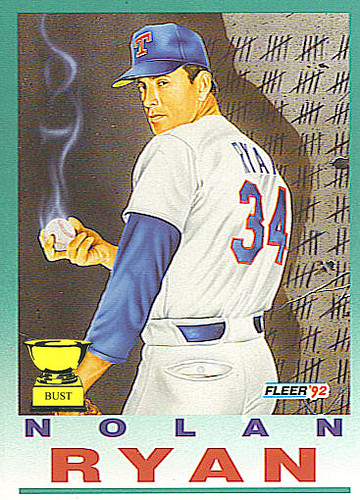
Nolan Ryan, 1989
32 GS, 16-10, 3.20 ERA, 301 SO, 1.086 WHIP
Fred Lynn Nolan Ryan Jr was lauded for his Texas home coming in 1989. Ironic since he was just cutting across state from Houston. No matter, the freaky hurler put together a huge 1989, fanning over 300 hitters and winning a solid 16 games, in spite of some tepid run support.

Fergie Jenkins, 1978
30 GS, 18-8, 3.04 ERA, 157 SO, 1.080 WHIP
Jenkins' second tour of duty in Arlington started with a bang, showing that this rangy Ranger could still bring it at age 35. Unfortunately, this was his last truly great season before age caught up with him. Well, age and a fine selection of contraband at the Canadian border in mid-1980.

Bert Blyleven, 1977
30 GS, 14-12, 2.72 ERA, 182 SO, 1.065 WHIP
The loopy Dutch hurler was a man without a country for much of his career, since he bounced between several different teams and likely affected his HOF chances as a result (of course, he's in as of 2011). His 1977 campaign in the Texas heat was a good one. This was the third lowest ERA of Blyleven's 22 year career.

Nolan Ryan, 1991
27 GS, 12-6, 2.91 ERA, 203 SO, 1.006 WHIP
This was Ryan's third massive 40+ year for the Rangers and also the year he spun off his record sixth no hitter.

Kevin Brown, 1992
35 GS, 21-11, 3.32 ERA, 173 ERA, 1.272 WHIP
A charter member of the MFS Anti-HOF, 1992 was Brown's first huge season and his 21 wins remains a franchise record. Solid performance but again, THIS is the fifth best season for a team that been around 40 years?!? Damn.

Monday, January 31, 2011

Book Report: Club 227


Single Season Runs + RBI > 227: The MFS Years (Three or more seasons)

Alex Rodriguez - Nine seasons
Seattle Mariners, 1996 (141 + 123 = 264)
Seattle Mariners, 1998 (123 + 124 = 247)
Seattle Mariners, 2000 (134 + 132 = 266)
Texas Rangers, 2001 (133 + 135 = 268)
Texas Rangers, 2002 (125 + 142 = 267)
Texas Rangers, 2003 (124 + 118 = 242)
New York Yankees, 2005 (124 + 130 = 254)
New York Yankees, 2006 (113 + 121 = 234)
New York Yankees, 2007 (143 + 156 = 299)

Albert Pujols - Eight seasons
St Louis Cardinals, 2001 (112 + 130 = 242)
St Louis Cardinals, 2002 (118 + 127 = 242)
St Louis Cardinals, 2003 (137 + 124 = 242)
St Louis Cardinals, 2004 (133 + 123 = 242)
St Louis Cardinals, 2005 (129 + 117 = 242)
St Louis Cardinals, 2006 (119 + 137 = 242)
St Louis Cardinals, 2009 (124 + 135 = 242)
St Louis Cardinals, 2010 (115 + 118 = 242)

Barry Bonds - Seven seasons
San Francisco Giants, 1993 (129 + 123 = 252)
San Francisco Giants, 1996 (122 + 129 = 251)
San Francisco Giants, 1998 (120 + 122 = 242)
San Francisco Giants, 2000 (129 + 106 = 235)
San Francisco Giants, 2001 (129 + 137 = 266)
San Francisco Giants, 2002 (117 + 110 = 227)
San Francisco Giants, 2001 (129 + 101 = 230)

Jeff Bagwell - Six seasons
Houston Astros, 1996 (111 + 120 = 231)
Houston Astros, 1997 (109 + 135 = 244)
Houston Astros, 1998 (124 + 111 = 235)
Houston Astros, 1999 (143 + 126 = 269)
Houston Astros, 2000 (152 + 132 = 284)
Houston Astros, 2001 (126 + 130 = 256)

Ken Griffey Jr - Five seasons
Seattle Mariners, 1996 (125 + 140 = 265)
Seattle Mariners, 1997 (125 + 147 = 272)
Seattle Mariners, 1998 (120 + 146 = 266)
Seattle Mariners, 1999 (123 + 134 = 257)
Cincinatti Reds, 2000 (100 + 118 = 228)

Sammy Sosa - Five seasons
Chicago Cubs, 1998 (134 + 158 = 292)
Chicago Cubs, 1999 (114 + 141 = 255)
Chicago Cubs, 2000 (106 + 138 = 244)
Chicago Cubs, 2001 (146 + 160 = 306)
Chicago Cubs, 2002 (122 + 108 = 130)

Frank Thomas - Four seasons
Chicago White Sox, 1993 (106 + 128 = 234)
Chicago White Sox, 1996 (110 + 134 = 244)
Chicago White Sox, 1997 (110 + 125 = 235)
Chicago White Sox, 2000 (115 + 143 = 258)

Gary Sheffield - Four seasons
Florida Marlins, 1996 (118 + 120 = 238)
Atlanta Braves, 2003 (126 + 132 = 258)
New York Yankees, 2004 (117 + 121 = 238)
New York Yankees, 2005 (104 + 123 = 227)

Juan Gonzalez - Four seasons
Texas Rangers, 1996 (89 + 144 = 233)
Texas Rangers, 1998 (110 + 157 = 267)
Texas Rangers, 1999 (114 + 128 = 242)
Cleveland Indians, 2001 (97 + 140 = 237)

Manny Ramirez - Four seasons
Cleveland Indians, 1998 (108 + 145 = 253)
Cleveland Indians, 1999 (131 + 165 = 296)
Boston Red Sox, 2004 (108 + 130 = 238)
Boston Red Sox, 2005 (112 + 144 = 256)

Todd Helton - Four seasons
Colorado Rockies, 1999 (114 + 113 = 227)
Colorado Rockies, 2000 (138 + 147 = 285)
Colorado Rockies, 2001 (132 + 146 = 278)
Colorado Rockies, 2003 (135 + 117 = 252)

Jason Giambi - Four seasons
Oakland Athletics, 1999 (115 + 123 = 238)
Oakland Athletics, 2000 (108 + 137 = 245)
Oakland Athletics, 2001 (109 + 120 = 229)
Oakland Athletics, 2002 (120 + 122 = 242)

Ryan Howard - Four seasons
Philadelphia Phillies, 2006 (104 + 149 = 253)
Philadelphia Phillies, 2007 (94 + 136 = 230)
Philadelphia Phillies, 2008 (105 + 146 = 251)
Philadelphia Phillies, 2009 (105 + 141 = 246)

David Ortiz - Four seasons
Boston Red Sox, 2004 (94 + 139 = 233)
Boston Red Sox, 2005 (119 + 148 = 267)
Boston Red Sox, 2006 (115 + 137 = 252)
Boston Red Sox, 2007 (116 + 117 = 233)

Albert Belle - Three seasons
Cleveland Indians, 1995 (121 + 126 = 247)
Cleveland Indians, 1996 (124 + 148 = 272)
Chicago Whites Sox, 1998 (113 + 152 = 265)

Dante Bichette - Three seasons
Colorado Rockies, 1995 (102 + 128 = 230)
Colorado Rockies, 1996 (114 + 141 = 255)
Colorado Rockies, 1999 (104 + 133 = 237)

Rafael Palmeiro - Three seasons
Baltimore Orioles, 1993 (124 + 105 = 229)
Baltimore Orioles, 1996 (110 + 142 = 252)
Texas Rangers, 1999 (96 + 148 = 244)

Carlos Delgado - Three seasons
Toronto Blue Jays, 1999 (113 + 134 = 247)
Toronto Blue Jays, 2000 (115 + 137 = 252)
Toronto Blue Jays, 2003 (117 + 145 = 262)

Magglio Ordonez - Three seasons
Chicago White Sox, 2000 (102 + 126 = 228)
Chicago White Sox, 2002 (116 + 135 = 251)
Detroit Tigers, 2007 (117 + 139 = 256)

Sunday, January 30, 2011

Book Report: Multiple 20+ win/200+ strikeout seasons during the MFS years


Rogers Clemens – Six seasons
Boston Red Sox, 1986 (24 wins, 238 strikeouts)
Boston Red Sox, 1987 (20 wins, 256 strikeouts)
Boston Red Sox, 1990 (20 wins, 209 strikeouts)
Toronto Blue Jays, 1997 (21 wins, 292 strikeouts)
Toronto Blue Jays, 1998 (20 wins, 271 strikeouts)
New York Yankees, 2001 (20 wins, 213 strikeouts)

Randy Johnson – Three seasons
Seattle Mariners, 1997 (20 wins, 291 strikeouts)
Arizona Diamondbacks, 2001 (21 wins, 372 strikeouts)
Arizona Diamondbacks, 2002 (24 wins, 334 strikeouts)

Curt Schilling – Three seasons
Arizona Diamondbacks, 2001 (22 wins, 293 strikeouts)
Arizona Diamondbacks, 2002 (23 wins, 316 strikeouts)
Boston Red Sox, 2004 (21 wins, 203 strikeouts)

Roy Halladay – Three seasons
Toronto Blue Jays, 2003 (22 wins, 204 strikeouts)
Toronto Blue Jays, 2008 (20 wins, 206 strikeouts)
Philadelphia Phillies, 2010 (21 wins, 213 strikeouts)

Steve Carlton – Two seasons
Philadelphia Phillies, 1980 (24 wins, 286 strikeouts)
Philadelphia Phillies, 1982 (23 wins, 286 strikeouts)

Jack Morris – Two seasons
Detroit Tigers, 1983 (20 wins, 232 strikeouts)
Detroit Tigers, 1986 (21 wins, 223 strikeouts)

David Cone – Two seasons
New York Mets, 1988 (20 wins, 213 strikeouts)
New York Yankees, 1998 (20 wins, 209 strikeouts)

Pedro Martinez – Two seasons
Boston Red Sox, 1999 (23 wins, 313 strikeouts)
Boston Red Sox, 2002 (20 wins, 239 strikeouts)

Monday, January 24, 2011

Book Report: The Ownage of Tom Gamboa


This is easily one of the most underrated moment during the past 10 years of MLB. A shirtless son/father combo engage in a little male bonding on field in Chicago and promptly get obliterated by 50+ professional athletes. To his credit, Royals first base coach Tom Gamboa took the incident in stride, especially considering the media were quick to paint him "the victim" and condem MLB (and pro sports in general) for their lack of security. Perhaps but maybe there is a reason that attacks of this nature in pro sports, in public are pretty remote: they're insane and hard to pull off. These two Chicago fellas were clearly morons ("[Gamboa] had it coming," claimed the father post-attack) and most sane folks wouldn't even contemplate attacking a first base coach in such a matter. An umpire, maybe.

Anyway, decent feature up top about how Gamboa has battled these "demons" in the years since.

Wednesday, January 19, 2011

Book Report: Five WTF 40 Home Run Seasons


5. Ryne Sandberg, Chicago Cubs, 1990, 40 home runs
Some day, Moseby Fears Satan will expose Ryne Sandberg for what he is: a very good but not great player. He was a servicable fielder, a good second basement in an era of piss poor second basemen and he brought a bit of pop in an EXTREMELLY home run friendly park. Yet he wasn't a power hitter. His 40 home runs in 1990 were by far a career high. In fact, he only topped 20 in 5 of his other 15 season. Yet he made 10 straight All Star Games some how. What the (heck)?

4. Javier Lopez, Atlanta Braves, 2003, 43 home runs
Only a handful of catchers reach 20 home runs in a season so Javier Lopez's 43 dinger performance in 2003 was a true rarity. Especially in an age 32 season. And (miraculously) in a contract year. As their known to do, the Baltimore Orioles took the bait and paid Javy close to $20 million to hit an additional 46 home runs... um, over the next three seasons. Considering that Lopez' previous career high was 34 six seasons earlier, not a huge surprise. Good hitter. Especially for a catcher. Just not 46 home runs worth of goodness.

3. Brady Anderson, Baltimore Orioles, 1996, 50 home runs
The chiselled good looks and manicured, McKay-esque sideburns of Brady Anderson could shield him from much finger pointin', allegations and naysayers. It's insane but 50 is 2x more home runs than Anderson hit in any other season and in fact, is almost 25% of his career total. This was one of the first signs that "something is up" during the mid-Nineties and really lead to a level of paraonoia that has plagued the game ever since.

2. Richard Hidalgo, Houston Astros, 2000, 44 home runs
I forgot about this guy. He was a complete beast in Houston 2000 but much like Morgan Ensberg a few seasons later, it was largely a one season thing. Actually, he did have a few other decent seasons but nothing that came anywhere close to 44 home runs. He was out of baseball by age 30, a victim of escalating salaries and the shrinking of MLB's middle class. Poor bastard also got carjacked in 2002. Ouch!

1. Todd Hundley, New York Mets, 1996, 41 home runs
I never liked this guy. Not personally but as a player. Yeah, it's cool he was a switch hitter but he wasn't a good fielder (threw out a mere 25% of runners for his career), he seldom hit above 0.250 and was a complete all-or-nothing hitter who struck out way, way too much. Yet he played for 14 seasons, perhaps buoyed by his famous father and his 1996 campaign, where he belted an incredible 41 home runs. Hundley hit a solid 202 home runs for his career but still, when you whiff a quarter of your at-bats, don't contribute much of anything defensively and are constantly making "bedroom eyes" at the Mendoza Line, you better be bringing the pop.

Thursday, January 13, 2011

Book Report: Hobby Pack Break!!!

A few comments...
1. I guess this is the 12-year old male equivalent of "haul" videos
2. No idea little kids were still into "cards"
3. Why would Geoff Blum have a card?
4. This lighting in this video is flawed
5. The 1987 Topps "wood" motif was pretty badass
6. The checklist cards are shit
7. The Todd Zeile and Bobby Bonilla mispronounciations were kinda cool, plus "Walt Waiz"
8. The last 10 seconds is horribly misleading

Sunday, January 2, 2011

Book Report: 10 Great (to Good) Final Seasons from 10 Great (to Good) Players


Mike Mussina
2008 New York Yankees
20-9, 3.37 ERA, 150 SO, 1.223 WHIP
39 years old
Comment: The Moose was just a winner. Plain and simple. This 20 win season kinda came out of nowhere and unlike the "I'm retired"/"No I'm not"/"Lather me up with growth hormones" hi jinx of a pair of fellow Yankee hurlers (not naming any names, of course), Mussina quietly excelled at awesomeness and gracefully bowed out with a 20 win season and plenty of class.

Kirby Puckett
1995 Minnesota Twins
0.314/0.379/0.515, 23 home runs, 99 RBI
35 years old
Comment: Puckett could've easily jacked another 1000 or so hits during the Steroids Era, had injuries and "demons" not tag teamed his pudgy ass out of MLB. A sad, sad story, since Puckett was so friggin' likable and so friggin' talented during his Twin City run. RIP.

Tom Henke
1995 St Louis Cardinals
36 saves, 1.82 ERA, 1.104 WHIP, 8.0 SO/9
37 years old
Comment: If it weren't for Dennis Eckersley and his flashy locks during the late Eighties/early Nineties, consummate professional closers like Tom Henke, Doug Jones and Jeff Montgomery would get more love in the eye of baseball historians and fat dudes who live in their parents' basement. Henke's final season in St Louis was especially immense.

Barry Bonds
2007 San Francisco Giants
0.276/0.480/0.565, 28 home runs, 66 RBI
42 years old
Comment: Now that his bulbous head has been gone for a few years, you can really start to appreciate the enormity of what Bonds accomplished. His rate stats, even in a quiet final year, are beyond insane.

John Tudor
1990 St Louis Cardinals
12-4, 2.40 ERA, 1.025 WHIP
36 years old
Comment: Yet another mention of John Tudor in MFS Land. Seriously, this guy could've etched massive career numbers if he just could've stayed healthy. Seasons like his 1990 "swan song" in St Louis show what this subtle saviour was capable of.


Will Clark
2000 Baltimore Orioles/St Louis Cardinals
0.319/0.418/0.546, 21 home runs, 70 RBI
36 years old
Comment: Will Clark was a effin' beast through out his career. Really intense and locked in. The guy quietly hit 0.300 or better in six of his last seven season, all at the age of 30 or older. And a career 0.333 post season average legitimized him as a big money player. He deserves some of the accolades that George Brett received back in the day. Same kind of hitter, really. Better looking, too.

Chili Davis
1999 New York Yankees
0.269/0.366/0.445, 19 home runs, 78 RBI
39 years old
Comment: It's surprising that Chili Davis wasn't more marketable during his career, since he offered a neat-o power/speed combo (at least early on), played in largely mid- to large markets (NY, LA, SF), had a cool nickname and was supposedly a real stand-up dude with reporters and teammates. At least comparable to Dave Parker without the 'tude.

Kenny Lofton
2007 Texas Rangers/Cleveland Indians
0.296/0.367/0.414, 86 runs, 23 SB
40 years old
Comment: Like Rickey Henderson, Lofton played for way too many teams during his twilight years. And yet unlike Rickey, he was still really, really productive through out. A dark horse HOF candidate IMHO. Perfect fodder for the 2031 Veterans Committee.

Mike Greenwell
1996 Boston Red Sox
0.295/0.336/0.441, 7 home runs, 44 RBI
32 years old
Comment: The Gator disappeared quietly in the mid-1990s but he never forgot how to rake off that dainty front pivot toe of his.

Don Mattingly
1995 New York Yankees
0.288/0.341/0.413, 7 home runs, 49 RBI
34 years old
Comment: Mattingly seems a bit overrated since he played in NY his whole career but kinda underrated when you see just how solid his career numbers were. A shame the Yanks started winning World Series's again the year after Donnie Baseball shut 'em down.

Wednesday, December 22, 2010

Book Report: Seriously Underrated Hats


Milwaukee Brewers (1978-1993). This hat is delightful on a few levels. OK, just one level but work with me here. The way the "M" and the "b" form the baseball glove is beyond brilliant. And the royal blue and yellow piping give this lid a vaguely aristocratic feel that can not be ignored. If you're curious, the logo was designed by Tom Meindel, an Art History student at the University of Wisconsin—Eau, so there is some serious Wisconsin lineage at work here. I always figured it must've originated from a clever Salvatore Romano-esque character in Chicago or something.


Seattle Mariners (1993-present). Granted, the nautical theme is a bit cliche but I dunno, something about this hat affects my inner core. It's modern, clean looking, modest yet powerful. Unlike the Mariners for most of their 30+ years. When Jay Buhner was "droppin' trou" and rockin' this logo in the mid-1990s, it was probably the closest that an MLB player ever came to resembling an actual longshoreman on the field. Past, present or future.


Detroit Tigers (1924-present). An underrated classic to be sure, this stylized "D" conveys the complexity of life in Detroit in a way few upper case letters can. Make no mistake, when you saw Jack Morris trotting in from the bullpen with this lid upon his skull, you knew that it was only a matter of time before he aiming a forkball at your crotch. Also, I loathe the orange version of this logo. It's horrible.

Sunday, November 21, 2010

Book Report: 10 Great Seasons by Pitchers with 0 Wins


Trevor Hoffman, San Diego Padres, 2006
0-2, 65 games, 2.14 ERA, 46 saves, 0.968 WHIP

Tom Henke, Toronto Blue Jays, 1987
0-6, 72 games, 2.49 ERA, 34 saves, 0.926 WHIP

Troy Percival, California Angels, 1996
0-2, 62 games, 2.31 ERA, 36 saves, 0.932 WHIP

Gregg Olson, Baltimore Orioles, 1993
0-2, 50 games, 1.60 ERA, 29 saves, 1.222 WHIP

Tom Henke, Toronto Blue Jays, 1991
0-2, 49 games, 2.32 ERA, 34 saves, 0.874 WHIP

Francisco Cordero, Milwaukee Brewers, 2007
0-4, 62 games, 2.98 ERA, 44 saves, 1.105 WHIP

Kazuhiro Sasaki, Seattle Mariners, 2001
0-4, 69 games, 3.24 ERA, 45 saves, 0.885 WHIP

Mike Henneman, Detroit Tigers/Houston Astros, 1995
0-2, 50 games, 2.15 ERA, 26 saves, 1.152 WHIP

Jason Isringhausen, St Louis Cardinals, 2003
0-1, 40 games, 2.36 ERA, 22 saves, 1.167 WHIP

Rod Beck, San Francisco Giants, 1996
0-9, 63 games, 3.34 ERA, 35 saves, 1.065 WHIP

Saturday, November 13, 2010

Book Report: Top Five WTF Silver Sluggers

Of all the MLB hardware handed out each fall, the Silver Slugger may be the most forgettable. It resides in that grey area between All-Star berth and MVP consideration and really, does little to arouse public interest—in spite of the super cool metal bats the recipients receive.


Time will tell if 2010 winners such as Jose Bautista and Alexei Ramirez are able to parlay their success into immortality beyond this calendar year. For the former, his 54 home runs was an incredible 38 above his career total and for the latter, he was simply the best of a bat lot, just finishing ahead of an aging Derek Jeter and an uninspiring Yuniesky Betancourt in the voting.

Thus, in the spirit of reality, here are the Top 5 WTF Silver Sluggers from years past.

5. Mike Stanley, C, New York Yankees, 1993
I’m actually a Mike Stanley fan so it pains me to put him on this list. In his brief time with my hometown Blue Jays in 1998, he proved to be a smart, serviceable hitter with good power, a good eye and a winning ‘tude. I just don’t think he was Silver Slugger material overall, although in fairness, his 1993 stats are pretty stellar for a catcher (0.305, 26, 84).

4. Rick Burleson, SS, California Angels, 1981
The 1981 version of Alexei Ramirez. Burleson was a vaguely useful middle infielder for the Angels and Red Sox in the late Seventies/early Eighties. But he wasn’t a slugger. Of any kind. Ever. He slugged 0.372 in the 1981 season for Christ sake. Total WTF, man. I guess the strike totally took out any semblance of offense for AL shortstops.

3. Jack Wilson, SS, Pittsburgh Pirates, 2004
See Burleson but add 200+ hits at least. Probably a better hitter than Burleson overall but he was sharing the league with solid, stand-up Latinos like Edgar Renteria and Rafael Furcal so it’s an oddity Wilson was able to slip through the cracks.

2. Joe Crede, 3B, Chicago White Sox, 2006
I never bought this guy as a quality big league regular and I have no clue why voters chose Crede over Alex Rodriguez and his 0.290/35/121 performance.

1. Manny Trillo, 2B, Philadelphia Phillies, 1980/1981
Trillo takes home top spot as perhaps the most decorated singles hitter in MLB history: 4 All-Star appearances, a World Series ring with the Phillies and incredible back-to-back Silver Slugger awards in 1980 and 1981. Trillo hit a COMBINED 13 home runs between the two seasons and slugged a paltry 0.406 during that span. Just brutal and the National League would continue to struggle at the position for much of the Eighties, making Ryne Sandberg appear Godlike in the process. If you’re curious, some of the other elite NL 2B of the era include a late thirties Joe Morgan, a young Tom Herr and a scrappy Phil Garner.

Thursday, November 11, 2010

Book Report: Evaluating MLB Action Figures

I'd be curious to see what type of person collects MLB "man dolls". Their rigid nature doesn't really make them ideal "play things" for children. In fact, I could see a toddler impaling themselves on one of these if they're not careful. They'd be best served on a shelf in a basement bar or "man cave" alongside lithographs of dogs playing pool and various napkins.


Alfonso Soriano
Rating: 5.5/10

This actually looks somewhat like Soriano, which is always a good start. The high socks lend themselves well to this type of thing. However, I find it very strange that they chose to depict Soriano in a fielding scenario, since his defensive skills are rather suspect. Given his non-performance with the Cubs the last few seasons, it may have been more fitting if the artist sculpted Soriano walking back to the dugout with a look of complete and utter indifference.


George Brett
Rating: 6/10

The stance is wrong. From what I recall, Brett had more of a pronounced lean in the batters box. This figure does have some quality nuances: the eye black, the creases in the uniform, scuffed shoes, the thoughtful facial expression. I also rather enjoy the home plate and how it's almost levitating. It gives the figure some Wiccan overtones.


Sammy Sosa
Rating: 2/10

This action figure is a piece of crap. It's wrong on so many levels, from the ridiculous facial expression, the lame attempt to capture Sosa's trademark skip/swagger, the disgusting playing surface and the floating bat, which is guaranteed to snap off if you handle this thing wrong. Also, Sosa was far more juiced when he was hitting all those home runs with the Cubs and I don't appreciate the insinuation that he kept that lithe, womanly figure he enjoyed back in his rookie season with the White Sox.

More critiques in the weeks and months to come.

Thursday, November 4, 2010

Book Report: MLB Heavyweights take to the TV


Alan Trammell and Lou Whitaker on Magnum PI: I like how they put a tickets to "the big game" on the table, all coy-like suggesting it's their "card". Smooth.


JJ Hardy, Bill Hall, Jeff Suppan, and Chris Capuano on The Young & The Restless: Capuano looks great here and shows off some considerable acting chops. Perhaps a fallback since "arm stuff" derailed a once promising career.


Wade Boggs introduces "Mr Perfect" Curt Hennig to the WWF: Perfect takes "King" deep as Boggs looks on in amazement. Perfect has a bit of McGwire-esque swagger in his follow-through.


Wednesday, October 27, 2010

Book Report: 1991 NLCS, Game Seven


CBS' opening for Game Seven of the 1991 NLCS has somehow found its way on to YouTube. And not a moment too soon.

I had this entire game on VHS cassette as a teenager and I must've watched it multiple times, as every aspect of this opening is crystal clear in my memory. From the frumpy old bag blowing the train whistle (was this a "thing" amongst Pirate fans) to Alejandro Pena enthusiastically slapping his glove, everything about this segment is fantastic. I blame the music. And Jack Buck's narration. CBS definitely got it right in terms of nuance and intrigue and while clips like these might come off as a tad heavy handed, they do a really nice job on conveying the suspense and drama of a Game Seven.

The early Nineties rivalry between the Braves and Pirates was underrated. A lot of it centred around Barry Bonds and his inability to hit in the post-season. But there was plenty of other subtext:

-The maturation of Tom Glavine, John Smoltz and Steve Avery as "the big three" (Avery clearly didn't hold up his end of the bargain long term)

- A sneak peek at Atlanta's bullpen woes that would plague them for much of the Nineties, though in fairness, Pena was pretty spot on during much of the 1991 post season

- Sid Bream switching teams during the 1991/1992 offseason and memorably chugging around the bases to put the Braves in the 1992 World Series. BTW how was this guy even a starting first baseman in MLB for so long and for play-off teams?!? He had limited power, a pained swing, terrible footspeed and only breathed through his mouth, I believe. I suppose his 1992 platoon with Brian Hunter wasn't terrible all told (combined 0.252 with 24 homeruns and 102 RBIs, though keep in mind Hunter spent some time in the OF). But still, Bream was basically a part-time talent in spite of his full-time mustache. Yeah.

- Pirate fans countering the Tomahawk Chop with something called the Power Hop, which is essentially a large scale group "hop" in efforts to quake Three River Stadium (Note: I may be off on the name but you can see an example of the Hop at 0:51 of the video)